




Executive summary
Chatwit’s leaders and business users kept asking the same kind of question: why did sales performance change? Every answer depended on technical staff to find the right data, write SQL, run several queries and interpret the results. DevOps TechLab deployed QueryDash, its agentic investigation platform built on Amazon Bedrock, so users can ask that question in plain language and receive a step-by-step, evidence-backed explanation. Every query is validated as read-only before it touches production data, and DevOps TechLab runs and improves the service as a managed engagement.
- Client
- Chatwit · Sales analytics
- Business problem
- Every answer to “why did sales change?” depended on technical staff writing and running SQL.
- What we delivered
- An AI investigation agent (QueryDash) on Amazon Bedrock with Amazon Nova Pro, connected read-only to Chatwit’s business data.
- Engagement
- Discovery, build and onboarding, then managed operations and continuous optimisation by DevOps TechLab.
- Outcome
- Business users investigate sales performance themselves, in plain language, with evidence for every finding.
The business challenge
Chatwit wanted its users to understand business and sales performance without waiting for a technical team. Getting to an answer meant identifying the right data, preparing SQL, running multiple queries and interpreting the results before anyone could act.
Why it mattered
- Decisions waited on analysts
Each new question had to go to technical staff, which slowed the move from a business question to an action.
- Skilled people on repeat work
Technical staff spent time finding data, writing SQL and running several queries for every request.
- Dashboards answer “what”, not “why”
Fixed reports show that a number moved. Explaining the cause meant connecting several data points by hand.
- Every follow-up started again
There was no way to keep the context of an investigation, so each follow-up question meant another request.
What Chatwit set out to achieve
- Let business users investigate performance in plain language, with no SQL and no ticket queue.
- Return explained, evidence-backed findings, not just raw numbers.
- Keep the context of an investigation so users can ask follow-up questions.
- Remove any risk to production data from AI-generated queries.
- Use one platform for new questions, instead of a new analytics project for each.
The solution: an AI analyst that investigates, not just queries
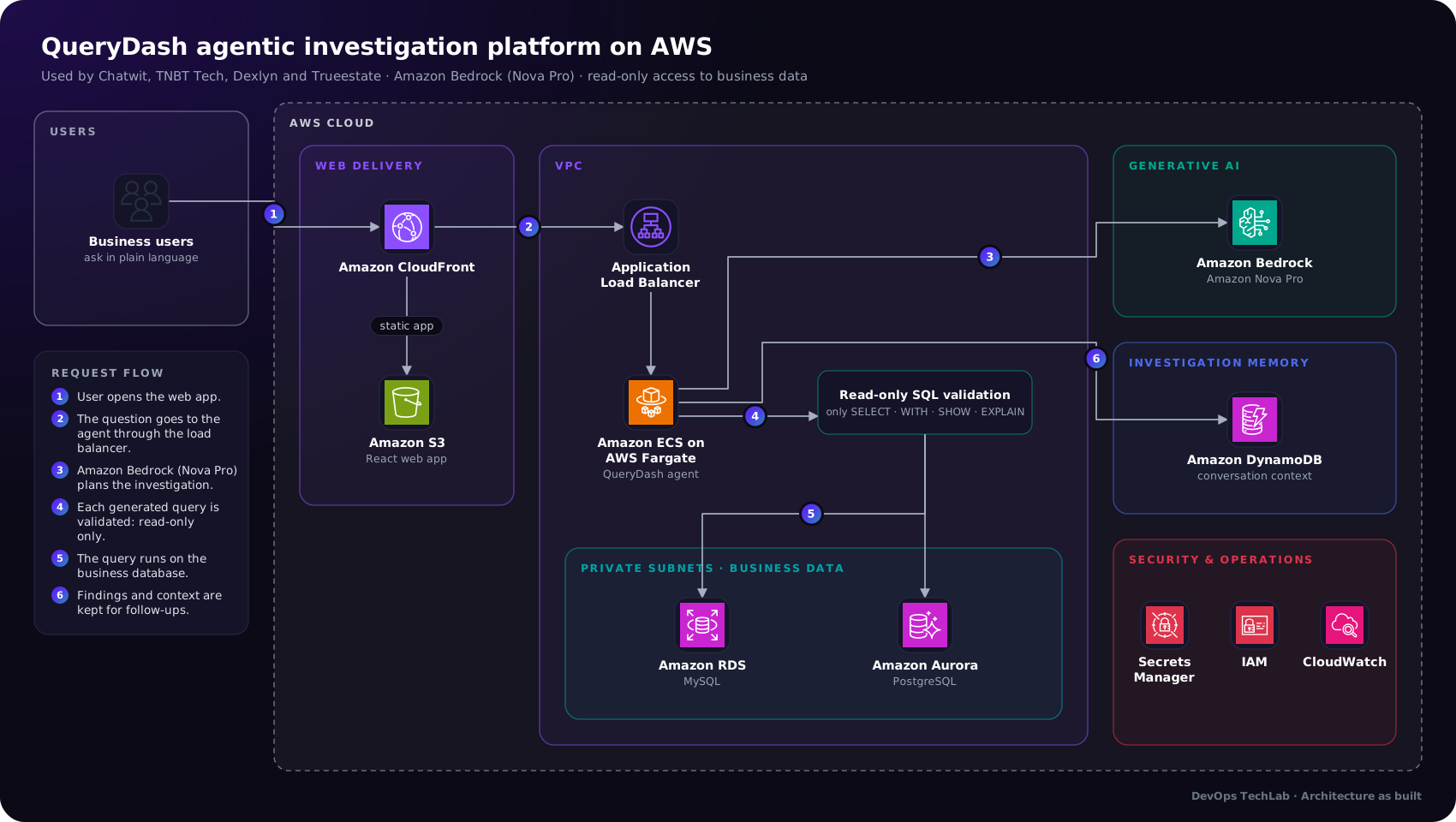
Users describe a business concern in plain language, for example “Investigate why sales performance changed and guide me through the findings.” The agent plans the investigation, finds the relevant data, writes and validates each query, analyses the results and decides the next step, recovering on its own when a query fails. Users watch the investigation unfold in real time and can ask follow-up questions in the same conversation.
Understand the goal. The agent restates what you are trying to find out.
Plan. It breaks the question into steps.
Discover the data. It finds the tables and columns that matter, and how they relate.
Generate SQL. It writes the SQL for the next step.
Validate: read-only. Every statement is checked before it runs. Writes and schema changes are rejected.
Execute. The query runs against production data, read-only.
Analyse. It reads the results and decides what they mean.
Replan or retry. If a query fails or the answer is incomplete, it adjusts the plan and tries again, until it can explain the answer.
Key design choices
- Managed generative AI
Amazon Bedrock with Amazon Nova Pro handles reasoning and tool use. There are no models to host and no GPU infrastructure to run.
- No servers to manage
The application runs on Amazon ECS on AWS Fargate behind an Application Load Balancer, so it scales with demand.
- Works on the data where it lives
The agent queries Chatwit’s existing operational databases directly, read-only, instead of copying data into a new warehouse.
- Conversations that remember
Amazon DynamoDB keeps the conversation and investigation history, so follow-up questions build on what the agent already found.
Security and governance
For leadership, the first question about AI on production data is risk. The platform is built so that AI-generated queries never touch the database directly.
- Read-only by design
Only read statements (SELECT, WITH, SHOW, DESCRIBE, EXPLAIN) are allowed. Any write or schema change is rejected before it runs.
- Validated before execution
Every query the AI writes passes through a server-side validation layer. The model never has a direct line to production data.
- Protected performance
Results are capped, so a broad question cannot turn into a runaway query on a production database.
- Managed credentials
Database credentials sit in AWS Secrets Manager, and access is governed by AWS IAM roles, not stored in code.
Architecture on AWS
| AWS service | Role in the solution |
|---|---|
| Amazon Bedrock · Amazon Nova Pro | Agent reasoning, planning and tool use |
| Amazon ECS on AWS Fargate · Application Load Balancer | Runs the investigation service without servers to manage |
| Amazon RDS (MySQL) · Amazon Aurora PostgreSQL | The business data the agent investigates, read-only |
| Amazon DynamoDB | Conversation and investigation memory |
| Amazon CloudFront · Amazon S3 | Delivers the web application securely |
| AWS Secrets Manager · AWS IAM | Credentials and access control |
| Amazon CloudWatch | Application, infrastructure and agent monitoring |
How we delivered
- 01Discover
Mapped the questions business users ask, the data behind them and how it relates, and defined secure, read-only access to production.
- 02Build & onboard
Connected Chatwit’s data, configured Amazon Bedrock and Nova Pro, set up read-only validation and conversation memory, deployed on AWS and tested against real investigation scenarios.
- 03Run
DevOps TechLab operates the service: monitoring the application, the AWS environment and the agent, managing credentials and access, and resolving production issues.
- 04Improve
Ongoing tuning of agent planning, query generation and recovery, plus reviews of performance, cost and security, and new investigation scenarios as Chatwit’s needs grow.
Business outcomes
Chatwit’s users now move from a business question to an explained answer in a single conversation, instead of a chain of requests to a technical team.
- Self-service answers
Business users investigate sales performance themselves, in plain language, without SQL or a ticket queue.
- Decisions backed by evidence
Each finding comes with the data, metrics and reasoning behind it, so leaders can act on it with confidence.
- Technical teams freed up
Less manual SQL analysis means engineers spend less time on repeat data requests.
- Zero write access to production
AI-generated queries are validated and read-only, so production data is never changed by the agent.
- A platform, not a one-off
New investigation scenarios are added on the same platform, without a separate analytics project for each.
What’s next
Because the architecture is reusable, Chatwit can extend the agent to new business questions without building a separate analytics workflow for each. DevOps TechLab continues to advise on new conversational analytics scenarios and further opportunities for AI-driven automation.
The same platform, other teams
DevOps TechLab is an AWS Advanced Tier Services Partner with the AWS Generative AI Competency and AWS SMB Competency. We design, build and run cloud and generative AI solutions on AWS for growing businesses, with 265+ cloud environments under management.
Want answers like these from your own data?
Share the questions your leadership team asks most often. We will show how an AI investigation agent on Amazon Bedrock could answer them, safely and read-only.